
Increasingly common, early childhood care plays an important role in children’s development and provides a valuable support to families with young children. It is therefore important to understand the impact of these services and to ensure their quality and accessibility.
Synthesis PDF Complete topic PDFInformation sheets
Download the free PDF version here or purchase hardcopy prints from our online store.
Child care – Early childhood education and care
High-quality child care services: a stimulating and caring environment for children
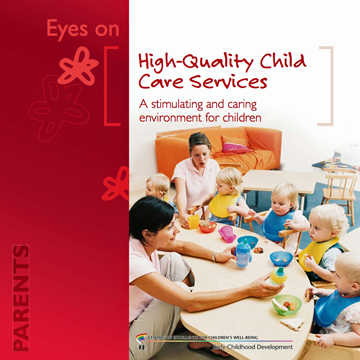
Synthesis
Topic Editor:
Topic funded by:
How Important Is It?
Early Childhood Education and Care (ECEC) has become the norm in many European and North American countries, where most children of 3 years and upwards attend a regulated early education service. In addition, early childhood services represent much more than a drop-off location for working parents, but play an important role in child development by giving children an opportunity to engage in a range of educational and social activities. The increasing number of children in formal ECEC is largely attributed, on the one hand, to the convergence of research showing the positive influence of early education on school readiness and, on the other, to the rise in maternal employment, although even children of stay-at-home mothers are likely to attend some type of child care. In the U.S., for example, the majority (63%) of women with children under 3 years spend time in the labour force and their children experience considerable amounts of non-maternal care.
Despite the increasing take-up of early development services, their quality is frequently low because of the costs associated with maintaining quality. High quality is characterized by a qualified, well-paid and stable staff, low adult-child ratios, and efficient management. Research suggests, however, that much formal child care in the United States is of weak quality and is associated with some modest but long-term developmental risks, especially when very young children (below the age of 18 months or so) spend long hours in such services. Adverse outcomes are not merely by-products of low-quality child care but stem also from stress caused by separation, which suggests that parental leaves should be extended to one year, which is the increasing practice in European countries.
What do we know?
Society and child care
There are many differences in the organization of early education and care systems. In most OECD countries, early education for children 3-6 years is a shared responsibility between the family and the state and is often free and fully subsidized. The situation is more mixed where ECEC for children under 3 years is concerned: many governments generously subsidise and support parents to access child care, but others see child care as primarily a parental responsibility. A laissez-faire approach to young children and families, characterized by weak state support and the predominance of private provision, can produce significant inequalities in access. The recruitment of migrant care providers in child care can also generate imbalances in the roles played by states, families, and markets in the child care sector in both North and South. Governments that see care and education as a public responsibility increasingly integrate their care and education systems and are able, in consequence, to ensure better regulation, more equitable access and provide higher quality services to all children.
The current discourse on choice for parents needs realistic assessment. Although parents are assumed to be free to choose the facilities they deem most appropriate for their child, access to high quality care is, in fact, often limited and unequal. This is a particular challenge in systems dominated by private for-profit provision. Low-income parents can “choose” only what is available to them and must often resign themselves to restricted choice and poor quality. In short, while early childhood care and education may be viewed as a central plank of inclusive policy, the reality is that these services serve, in too many countries, to widen the education gap. This is particularly the case for immigrant and ethnic children, the parents of whom are greatly limited in their choice of services by environmental and economic constraints.
Democracy should be the fundamental principle that guides the provision and elaboration of ECEC services not only at the early childhood level by encouraging shared decision-making at local level, but also at community and political levels by making early education a matter of public debate and collective responsibility. In a democracy, individuals express not only personal preferences; they also make public and collective choices related to the common good of their society.
The impact of child care on child development
Child care settings have been linked to both positive and negative consequences for child development. Despite contradictory earlier findings about the effects of child care on cognitive and linguistic development, more recent research has consistently documented the enduring and positive effects of high-quality child care. Much research evidence exists to show that high quality early education provides a solid foundation for school readiness and academic achievement but selection bias is a potential problem for most studies of child care as it may confound variations in child and family characteristics with variations in child care contexts. Learning experiences in ECEC can also help children develop democratic values as well as social skills. A close bond with a care provider is also an index of the quality of future relationships. A caring environment is particularly valuable for children who experience insensitive care at home by reducing the risk of behavioural problems, serving as a protective factor and by providing opportunities for improved cognitive and language development. On the other hand, when combined with social and economic stressors at home, inadequate ECEC arrangements (poor quality child care, long hours, and instability) represent a double-threat to children’s attachment security. However, it is often difficult to identify ECEC as the cause of various developmental outcomes because of inseparable confounding factors, such as, issues of stability in care-giving and the characteristics of individual children and their families. The effect of child care is likely to vary not only based on these characteristics, but also as a function of the child’s personal traits and the ideologies surrounding child care in a specific cultural context.
What can be done?
Enhancing children’s experience in early child care requires that families, staff, administrators, and policy makers work together to address current challenges. In the early childhood centres, more attention needs to be given to appropriate pedagogies that reinforce the well-being and involvement of young children. At the family level, parents are encouraged to fulfill their child’s needs for close and private interactions and to create supportive connections between life at home and in the child care setting.
Children’s experience can also be improved through the quality of ECEC services they receive. A high quality facility is one with qualified, well-paid, and regular care providers, reasonable adult-child ratio, and proper management. ECEC providers can boost the quality of care by being sensitive and empathic toward the child, e.g., helping them deal with the transition from home to child care and by providing activities that stimulate the child’s participation and communication. The aim should be to provide enriched interactions that encourages deep rather than shallow learning, exchange of ideas. Children’s involvement can be improved through activities that support the child’s autonomy (e.g., the introduction of new and challenging activities; responding to children’s ideas and interests; encouraging movement and exploration; allowing children to have a say in rule-setting). Policy makers and care providers are also responsible for ensuring that all children have access to the same quality and amount of care. Close attention should be given to emotional and developmental problems so that early interventions can be integrated into the child’s routine. The child care setting should also provide a healthy and safe physical environment with a high adult-child ratio to ensure children’s well-being.
The democratic administration of child care services can play a key role in enhancing the child care setting by involving community, staff, parents and children in the decision-making process. A good child care program is one that acknowledges diversity, is unbiased and offers affordable high quality care to and offers affordable high quality care to disadvantaged and at-risk children. Appropriate remuneration, a solid education and ongoing training for all child care providers are essential to promoting the standing of the early childhood sector.
Improving the child care system is highly dependent on government support. Concrete actions by policy makers, already practised in many counties, are: matching paid parental leave to the rate and duration observed in Scandinavian countries; providing adequate public funding and developing tax policies that allow parents to make appropriate child-rearing choices, paying greater attention to children from poor or diverse backgrounds; integrating child care and early education under one ministry or agency and thereby enhancing quality, qualification requirements, accessibility and affordability.
Discover more

Why is high-quality child care important for child development?
High quality child care can have a positive influence on children’s development and school readiness by providing valuable educational and social experiences. High quality child care is characterized as:
Having well-qualified, well-paid, stable staff, low child-adult ratios, and efficient management.
Offering a program that covers all aspects of child development (physical, motor, emotional, social, language and cognitive development).
Research shows also that only high quality provision can deliver well-being and appropriate development to young children. As an increasing number of mothers are in the workforce and most children ages 3 and older now attend a child care facility on a regular basis, it has become critical that young children from all backgrounds should have access to high-quality child care and early education.
Publications
Child Care and the Development of Young Children (0–2)
Early Childhood Education and Care Systems: Issue of Tradition and Governance

Resources and bulletins
Thematic bulletin
Volume 3, No. 1 - March 2004
The Encyclopedia also recommends...
Twelve Flawed Statements of the Fraser Institute on Quebec’s Childcare Program
by Pierre Fortin, Department of Economics, School of Management, University of Quebec at Montreal
Early Childhood Education Report 2014: It's Time for Preschool
Novembre 2014
Why is high-quality child care essential? The link between quality child care and early learning
Lessons in Learning, Early Childhood Learning Knowledge Centre, Canadian Council on Learning, May 2006