
Social cognition, sometimes called emotional intelligence, plays a major role in children’s social and emotional development. It is therefore important to understand what it is and how a child’s environment can affect the development of this skill.
Synthesis PDF Complete topic PDFInformation sheets
Download the free PDF version here or purchase hardcopy prints from our online store.
Social cognition
Social cognition: helping your child understand people’s thoughts and feelings
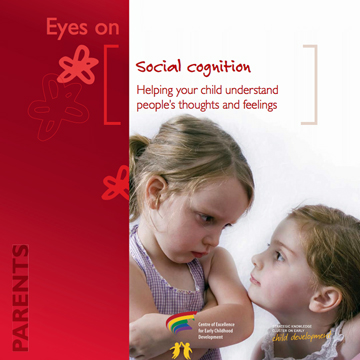
Synthesis
Topic Editor:
How important is it?
Social cognition refers to the awareness of one’s own and other people’s mental states (i.e., acquiring a theory of mind), including emotions, motives, desires and feelings. Socio-cognitive skills, such as the ability to understand, describe and predict people’s mental states, allow children to develop a strong social cognition. Developing social and cognitive awareness is especially important during infancy to prepare children to interact properly with the social world prior to school entry. For example, it is through group activities that children gradually learn the importance of sharing. This crucial ability originates from children’s understanding that other children may have a desire to play with the same toys.
Along the same line, recent evidence indicates that children’s socio-cognitive skills may have a direct impact on the quality of their relationships and school success. Children with a more developed social cognition tend to be better communicators, socially competent, popular with peers, happier at school, and academically more advanced. In contrast, those with poor social cognition are more likely to have difficulty making the transition to school, to react more violently in face of harsh parenting, and to experience difficulties in school that may be misread as conduct problems (e.g., lacking respect towards a teacher).
Lastly, it is important to foster early children’s socio-cognitive skills because they have a bigger impact on children’s social and academic development when acquired at a young age.
What do we know?
Recent evidence indicates that social cognition begins early in life, even before language acquirement. Prior to age one, infants are able to follow the attention of others, to participate in simple turn-taking games (e.g., pick-a-boo), and to have an understanding of goal-directed behaviours, such as grasping or reaching for an object. Then, around the age of two, children become increasingly aware that others experience mental states that are different from their own. For example, they recognize that somebody else may like something they do not like. As preschoolers develop language abilities, they become able to understand the perspective of others which leads to changes in social behaviour including an increase in empathic and prosocial behaviours. Although the transition from intuitive to reflexive social understanding develops progressively, differences in social cognition depend both on child and family factors.
Children with strong social cognition tend to have stronger language abilities, emotion regulation and executive function skills (e.g., planning skills, self-control, and cognitive flexibility). By controlling their behaviours and emotions, they are better able to take another’s perspective and to get along with others. Furthermore, family factors, including a positive parenting style and siblings relationships, contribute to children’s social and cognitive understanding. Specifically, children tend to develop early socio-cognitive skills when secure attachment and guidance are provided by parental figures. Lastly, interactions between siblings, either positive or negative, have an additional impact on children’s cognitive outcomes. For example, siblings provide the child an opportunity to engage in pretend play, in family conversations, provocation and teasing. In fact, even disputes foster social cognition through reconciliation of different points of view.
What can be done?
Children’s social cognition can be enhanced by several activities performed within the family. Given that children’s ability to inhibit their impulsive thoughts/ behaviours (i.e., executive functions) tends to act as an important predictor of social cognition, parents should provide an adequate balance of guidance and autonomy when playing with their children. Activities that involve talking about people’s thoughts, desires, and feelings, and the reasons why they act the way they do should be privileged. For instance, engaging children in joint pretend play is one way for them to recognize that the expression of emotions and behaviours varies from one person to the next. Another highly recommended activity is story reading. While questioning children on various events occurring in stories, especially those involving tricks, secrets or mistakes, parents help children to adopt the perspective of others (e.g., asking children whether they believe the Red Riding Hood knows that the wolf is dressed as her grandma). Furthermore, providing reasons when correcting children’s misbehaviours is highly recommended because it helps children to develop an early awareness that people experience different feelings or desires. Lastly, a sensitive and caring parenting style is especially beneficial when interacting with children in various activities (e.g., peek-a-boo, pretend-play, picture-books). Through positive dyadic exchanges, children have the opportunity to improve their social and emotional learning which in turn sets the stage for positive interactions within the peer groups. Indeed, these social behaviours not only promote social cognition but also teach children how to positively interact with their peers while reducing the likelihood that their social and cognitive understanding will lead to antisocial behaviours (e.g., teasing, bullying, and lying).
Discover more

Why do social cognition skills lead to more positive relationships with others?
Children who become aware of their own and other people’s emotions, motives, desires, and feelings are better able to understand, describe, and predict people’s mental states – thoughts, wants and feelings.
In turn, these skills help them to:
Know how to respond to the actions of others.
Become sensitive to the psychological state of others.
Engage in empathic, cooperative, and pro-social behaviours (e.g., sharing toys and helping others in need).
Adopt the perspective of others (e.g., in pretend play).
Beyond these benefits, social cognition skills help children to develop stronger language abilities making them better communicators.
Publications
The Development of Theory of Mind in Early Childhood
Early Peer Relations and their Impact on Children’s Development